


Every couple of years, someone declares SEO dead. First it was voice search. Then it was social media. Now it's AI: why would anyone click on a website when ChatGPT just hands them the answer?
I hear some version of this from business owners all the time, usually after someone (often someone selling something else) has told them Google is finished. I spent years as a journalist before I got into marketing, so instead of arguing about it, I went and looked at the numbers. Then I looked at the websites of the businesses we've been talking to here in the Riviera Maya.
Short version: SEO isn't dead. It changed. And most local businesses aren't doing the basics yet.
Google is still enormous
Google says it now sees more than 5 trillion searches a year. That works out to roughly 13.7 billion searches a day.
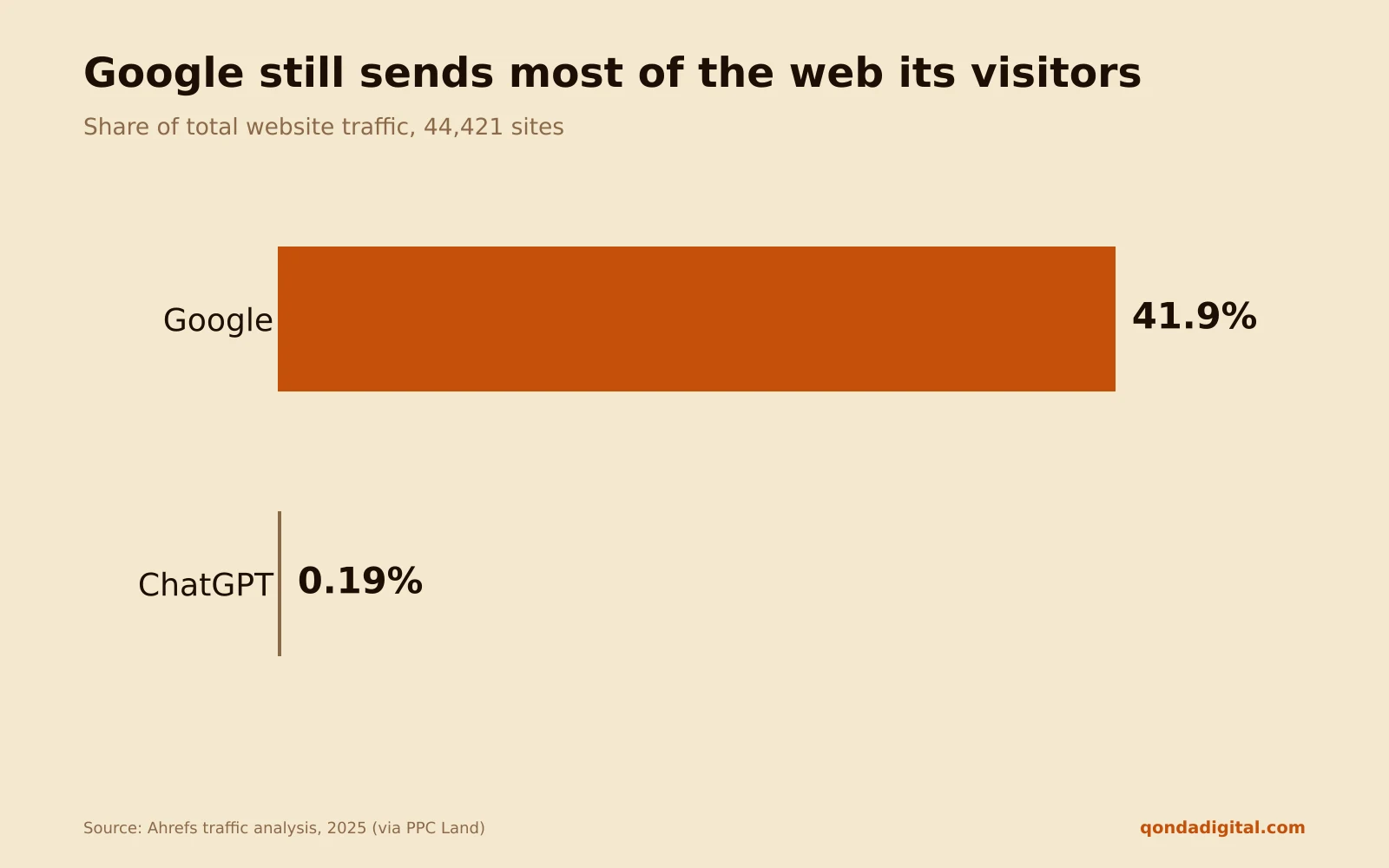
Then there's where traffic actually comes from. When Ahrefs looked at 44,421 websites, Google sent them 41.9% of all their visits. ChatGPT sent 0.19%.
To be fair, ChatGPT is growing fast. Semrush's clickstream data shows its referral traffic grew 206% between January 2025 and January 2026. But it's growing from a tiny base. Triple 0.19% and you're still well under 1%.
People also aren't switching. They're adding. Similarweb found that 461 million of ChatGPT's 494 million users also used Google. That's 95%.
What actually changed
I'm not going to pretend nothing's different. Google's AI Overviews, the AI-written summaries that now sit at the top of many search results, are taking clicks. Ahrefs studied 300,000 keywords and found that when an AI Overview shows up, the top-ranking page gets 58% fewer clicks.
That's real, and anyone who tells you otherwise isn't paying attention. Ranking first for a general question like "how long does a dental implant last" is worth less than it used to be.
But think about the searches that actually make a local business money: "dentist in Tulum," "custom home builder Akumal," "condo for sale Puerto Morelos." Nobody gets their teeth fixed by reading a summary. At some point they still have to pick someone, and to do that they click, call, or check the map.
And those AI answers have to come from somewhere. In May 2026, 6.8% of ChatGPT answers in the US linked to an outside website, up from about 1.6% a year earlier. AI assistants read the same web Google does. A website Google doesn't trust is not likely to be the one an AI recommends.
Local search is where small businesses win
This is the part that matters most for the businesses we work with. According to BrightLocal's latest consumer research:
- 97% of consumers read reviews for local businesses.
- 71% use Google Search at some point while looking for a local business, and 52% start there.
- 46% say they "always" or "often" add "near me" to their searches.
- 45% now use ChatGPT or other AI tools for local recommendations. Those tools get their information from your website, your listings, and your reviews.
And here's the opportunity: BrightLocal found that only 35% of small businesses even have a Google Business Profile. Most of your competitors aren't doing this well. Some aren't doing it at all.
Ads work. They also stop.
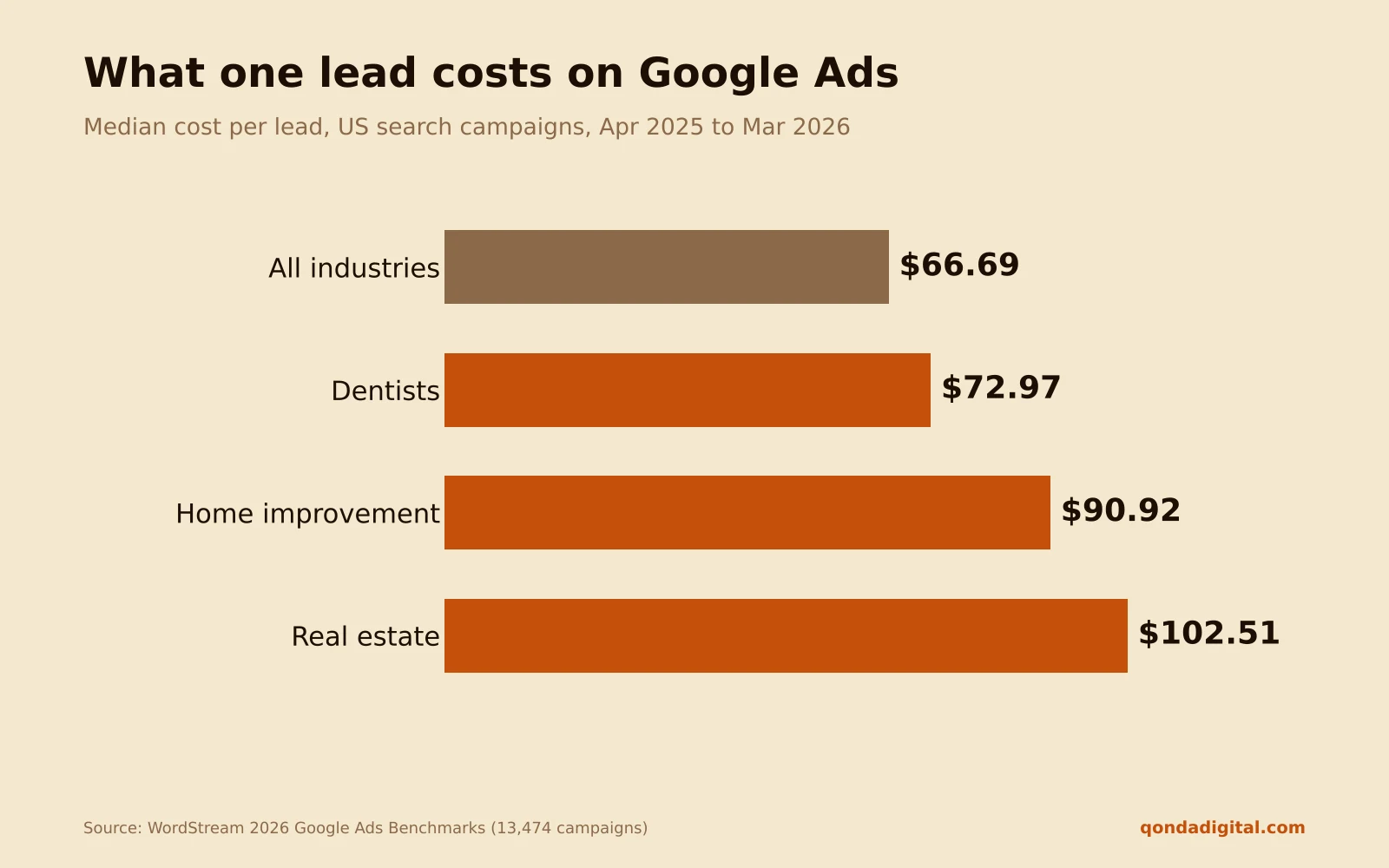
We run Google Ads for clients, and they're great for bringing in leads quickly. But they're not cheap. WordStream's 2026 benchmarks, based on 13,474 US campaigns, put the median cost of a single lead at $66.69, and higher in the industries we see most around here.
The day you stop paying, those leads stop. SEO is slower to get going, but what you build keeps working. A page that ranks this year can still be bringing in inquiries next year, and you're not paying per click for it.
The smart move is usually both: ads to bring in leads now, while organic search builds underneath.
What we're seeing in local audits
Here's where it gets personal. Over the past few months we've audited the websites of nine businesses, most of them here in the Riviera Maya: builders, real estate developers and agents, a dental clinic, a resort, a manufacturer and a logistics group. All the data comes from Search Atlas, the SEO platform we use. I'm not naming anyone, but the numbers are real.
Most are nearly invisible to Google. Of the seven sites where we measured traffic, six got fewer than 120 visits a month from Google. Two got zero. At least three had no keywords at all on Google's first page.
Authority is close to zero. Search Atlas gives every site a Domain Power score out of 100, a measure of how much authority Google is likely to give it. Seven of the eight sites we could score had a Domain Power of 12 or lower. Only one cleared 20.
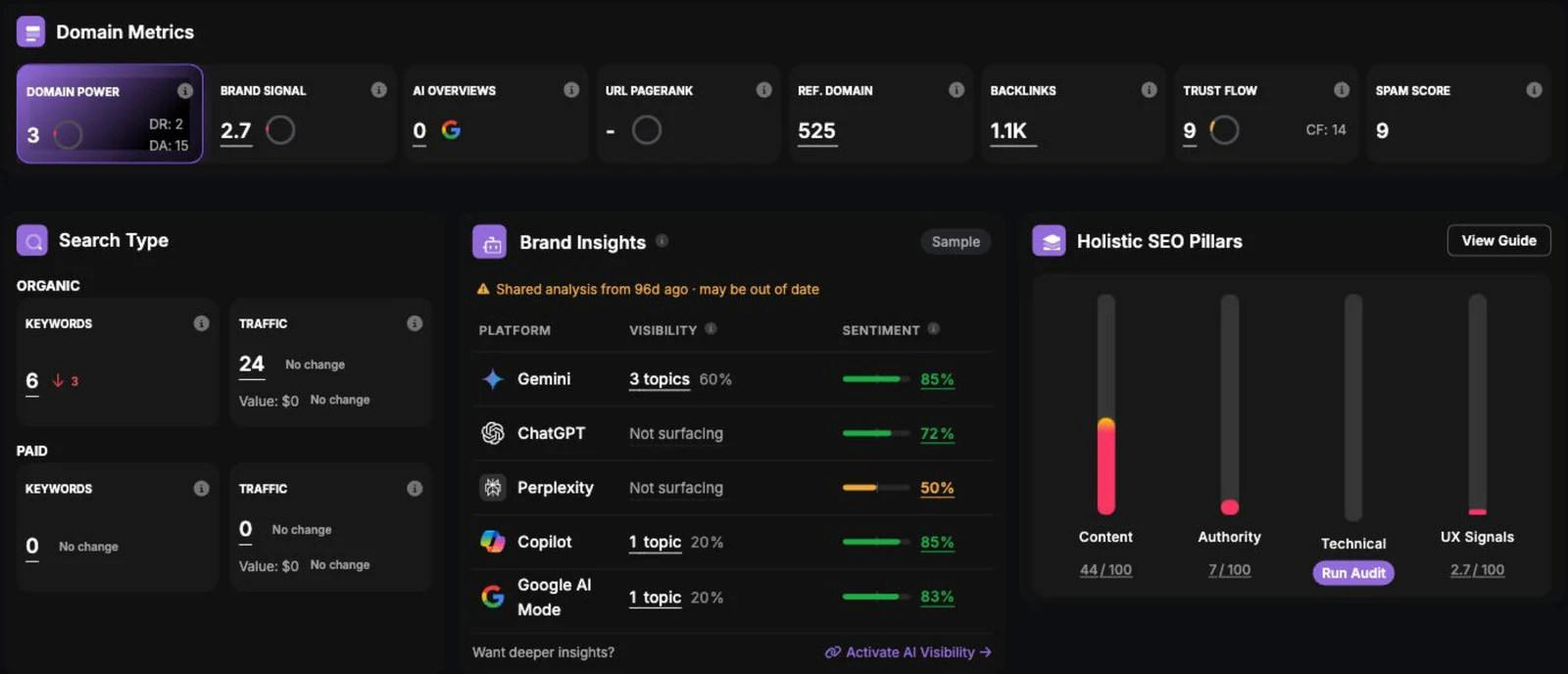
Content is thin. None of the seven sites we scored for content broke 50 out of 100. Three scored 13 or lower. One clinic's entire website was a single page. One company's "website" was a social media link-in-bio page.
Bad links are everywhere. Four of the nine had backlink profiles full of spam: links with anchor text like "premium high DA backlinks" and "high quality dofollow," often from sites with nothing to do with their business. That usually means someone, at some point, bought cheap links. Google notices, and it drags the whole site down.
Foreign buyers can't find them. Five businesses that sell to Americans and Canadians got zero organic visits from at least one of those countries. One real estate developer, viewed from the US, had zero keywords and zero traffic.
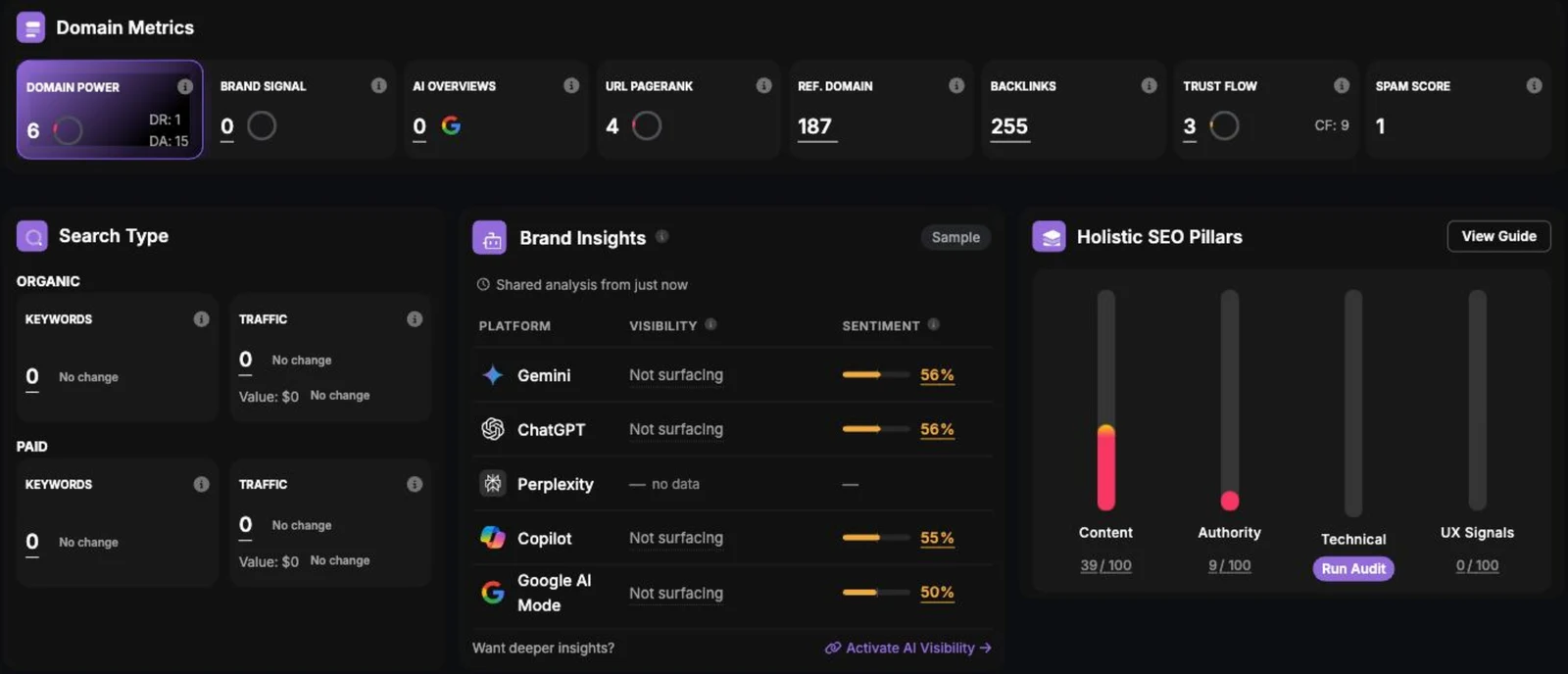
Great reputations, hidden online. This is the one that gets me. One dental clinic had 248 Google reviews at 4.9 stars, more than any direct competitor, and still had zero keywords on page one in any country. A resort had a perfect 5.0 from 77 reviews and only showed up when people searched for its name.
These aren't bad businesses. Most of them are very good at what they do. Their websites just aren't telling Google that.
Where to start
You don't need to do everything at once. If I were a business owner reading this, here's where I'd start:
- Claim and complete your Google Business Profile. Hours, categories, services, photos, and a post every week or two.
- Ask every happy customer for a review, and reply to every review you get, good or bad.
- Give every service its own page. Google ranks pages, not websites. One page that covers everything ranks for nothing.
- If you sell to foreigners, build a real English version. Written by a person, not machine-translated. Google can tell, and so can your customers.
- Find out who's linking to you. If you see anchor text about "premium backlinks," someone bought links in your name. Clean them up.
- Test your own contact form. One business we audited had a contact form that didn't work at all. Every lead that tried it went nowhere.
Let's take a look at yours
At Qonda Digital, this is what we do every day: SEO, Google Business Profiles, bilingual websites and content, and the ads and automation that tie it all together. We work in English and Spanish, with the people who buy from you on both sides of the border.
If you want to know what your numbers look like, we'll walk you through a free 30-minute audit. You keep the findings either way.
Email me directly at ty@qondadigital.com to arrange a free call.